Track rail applications: four settings, one way of counting
Every setting below uses the same arithmetic: legs, corners, an assumed stock length and a wire system. What changes is how often the layout turns, how the ceiling takes a fixing and how many groups of heads the space needs. Read the setting closest to yours, then count your own run in the rail parts planner.
Fashion and retail floors
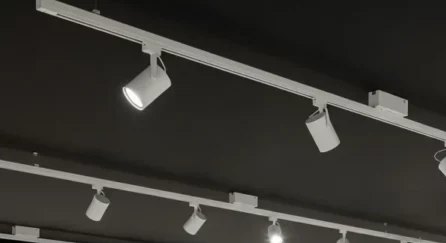
Displays change more often than ceilings do. A track rail lets heads move along the run when the floor is re-merchandised, so the rail is planned around the long lines of the floor rather than around each display. Retail runs often turn round columns and bulkheads; each turn starts a new leg and adds a corner connector, so count per leg.

Galleries and exhibition walls
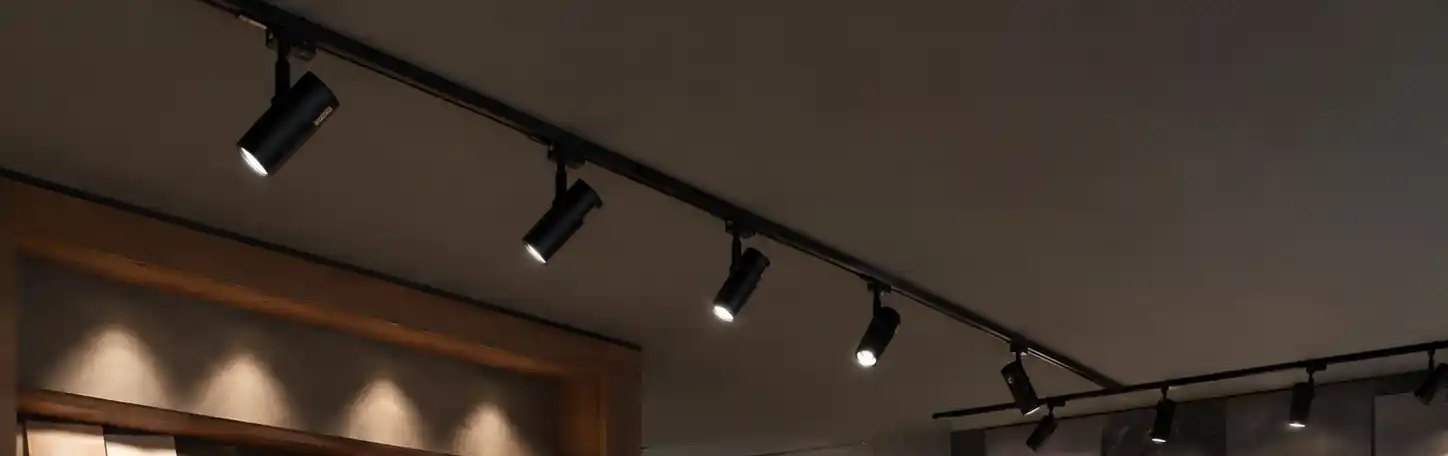
Gallery runs usually follow the walls at a set distance, which turns a room into an L, a U or a closed rectangle. A rectangle has no open ends and needs no end caps, but a long loop may need a second feed point. Ask how the heads will be grouped before choosing the wire system, not after the walls are hung.
Materials and product showrooms
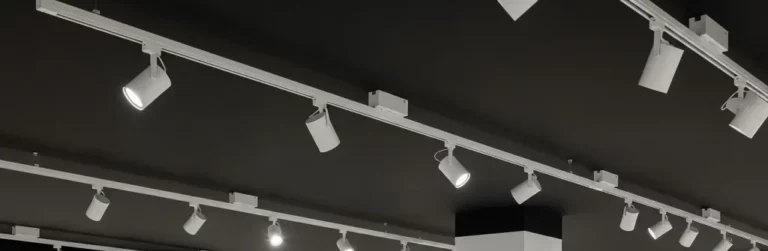
Showrooms tend to run long, straight bands of rail across the space, sometimes several in parallel. Each band is its own run with its own feed and two end caps. Running the planner once per band keeps the counts clean and makes it easy to see where a different stock length would save joiners.
Long perimeter and aisle runs
Long runs along an aisle or a shop perimeter are where small parts add up. A long leg at a short assumed stock length means many straight joiners, and the finish of every joiner shows on a white ceiling. Confirm the rail lengths actually available for the system so the joiner count reflects the real rail.
The same three checks in every setting
- How the heads are grouped and switched — confirmed for the exact wire system.
- Ceiling type and access, which decide the mounting method and can force the layout to turn.
- Heads matched to the rail wire system and voltage.
For background on choosing a system, read 2-wire vs 3-wire vs 4-wire track.
Describe the space, send the count
Tell us the setting, attach the planner list and a sketch of the ceiling. We'll confirm the rail, feed and mounting for that system.
- Email · [email protected]
- Phone / WhatsApp · +86 159 8611 6737
- Factory · Danzao, Nanhai, Foshan