Suspension and recessed fittings for lighting track
The ceiling interface belongs in the lighting-track order as early as the rail itself. Sampo supplies suspension and recessed installation parts for conventional lighting track systems. The right discussion begins with the supporting construction, the selected rail model and the intended position of the lighting line. Show how the run will meet the ceiling, then confirm the mounting accessories and fixing spacing per model and ceiling. A rail length total cannot describe that interface on its own.
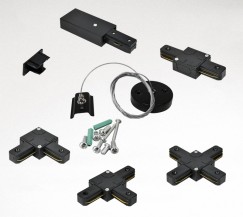
Draw the lighting line below the supporting surface
A suspended route places the rail beneath the fixing surface. Mark the intended position of the rail and explain what it needs to align with: display faces, a counter, a circulation line or another element of the room. Include the proposed drop and any changes in ceiling level so the suspension discussion starts from the actual geometry.
Show where the route turns or branches, because those places can influence the support arrangement that needs review. Keep the lighting intention visible as well as the structure. A run that looks correctly positioned on a plan still needs its elevation understood before rods, wires and associated fittings can be discussed for the specific model.
Describe rods and wires as installation questions
Suspension kits may be described using rod or wire terminology. Ask for the proposed fitting arrangement and its match to the selected rail rather than choosing from terminology alone. Include the ceiling construction, the drop and the access available above the rail. The precise support method has to be reviewed with the actual mounting and profile details.
Do not assign a universal spacing to support points. Fixing spacing is confirmed per model and ceiling, with the layout and intended head arrangement available for review. Mark proposed points as a coordination drawing until the selected model requirements have been checked. This makes it easier to see which ceiling locations require a suitable fixing solution.
Bring recessed details into the ceiling section
Recessed fittings need a section through the ceiling build-up, not just a line on its underside. Show the proposed opening, finish edge and access around the rail. Ask for the exact profile and installation drawing so the ceiling work can be coordinated with the selected model. A flanged appearance alone does not establish the required construction detail.
Consider the sequence of installation and finishing. Identify who prepares the opening, who fixes the rail and when the electrical connection will remain accessible. These questions help avoid discovering a missing interface after surfaces have been finished. The recessed rail discussion provides a route for preparing those model-specific questions.
Keep connectors clear in the support plan
Rail joins, corner pieces and feed positions should remain visible on the mounting drawing. A support arrangement needs to be coordinated with the assembled route, including the positions of the components it supports. Do not erase those junctions when simplifying a ceiling plan for the fixing discussion; they are part of the physical installation.
Check whether a planned fixing location conflicts with a junction, ceiling service or access requirement. Ask for guidance against the selected model and construction rather than moving supports by guesswork. A revised rail division may change where straight joiners land even when the overall route stays the same, so retain both the rail schedule and the mounting notes.
Review the finish from the occupied room
Surface, recessed and suspended routes produce different visible lines. Look at the proposed rail from doorways, seating positions and the main display direction, not only from directly below. Suspension makes the relation between rail and ceiling more visible; recessed work makes the finish edge and alignment especially relevant to the room appearance.
Confirm black and white finishes for the selected model when reviewing visible fittings. Review the proposed rails, mounting accessories, feeds and connectors together where visual coordination matters. Keep that review separate from the mechanical check: matching colour is useful, but it does not establish that a suspension attachment or recessed part belongs to the intended rail.
Send the mounting package with the rail enquiry
Include a plan, relevant ceiling section, proposed drop or recess condition, wire-family request and head schedule. State the ceiling construction and identify questions about access or support locations. Confirm head compatibility by wire system and voltage, and request model-specific rail specifications alongside the installation details.
Sampo supplies rails, matching heads and parts as sets, and rails and parts separately for OEM and assembly customers. For a structural part request, provide the drawing or sample and the intended mating rail. For a ceiling installation enquiry, send the current mounting sketch with the rail and parts request so the fittings can be considered with the route they must support.